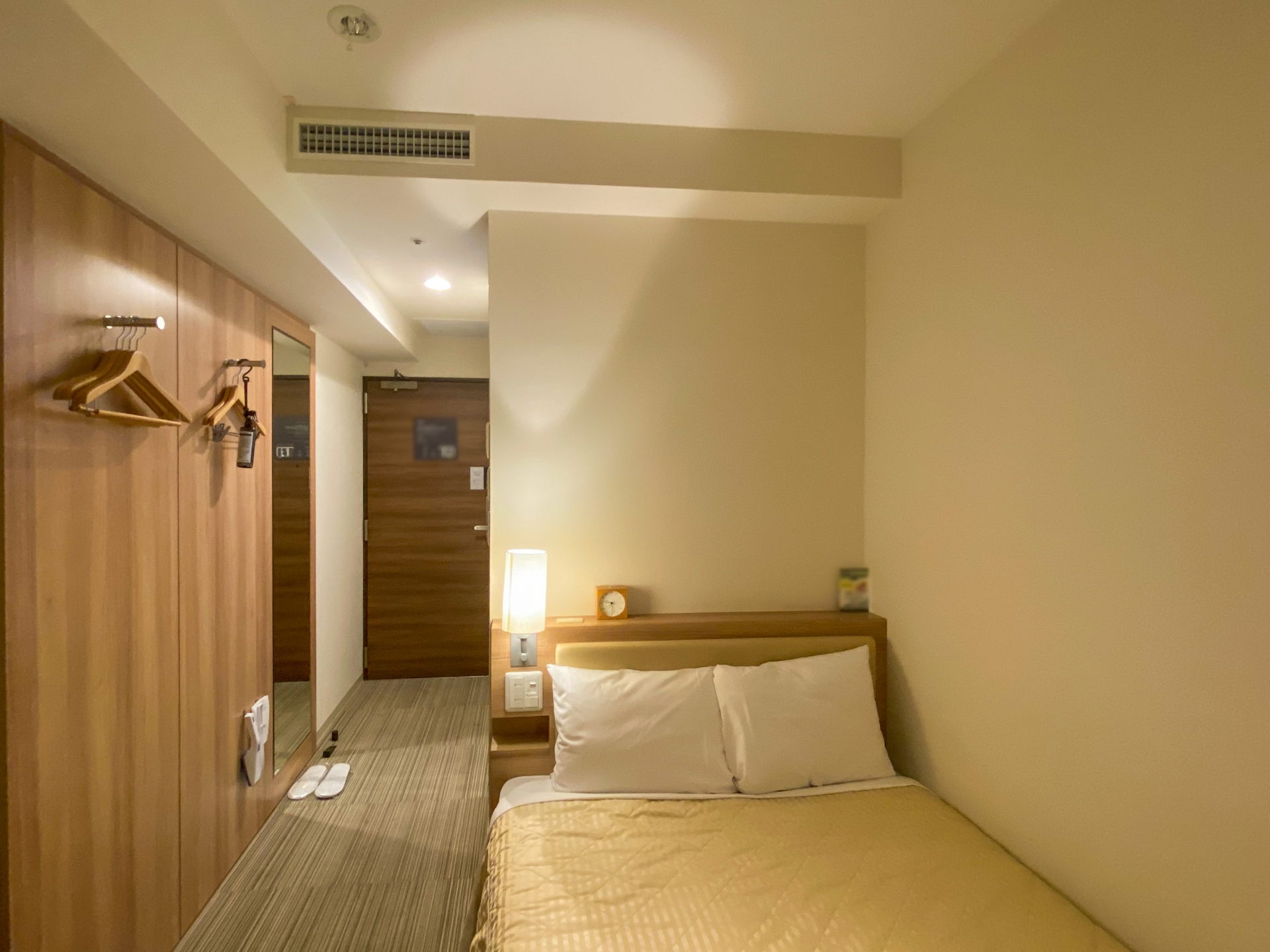
The 'Semi-Double' Myth: Why Your Bed Might Be Smaller Than You Think
One of the biggest lessons I learned in 2026 is that a 'Double Room' in Japan is not the same as a Double in the US or Europe. You’ll often see something called a 'Semi-Double.' I made the mistake of booking one with 12sqm of space, thinking it would be Cozy. It was beyond cozy—it was tight! In 2026, a Semi-Double is typically a bed that's only 120cm wide. For two adults, it’s basically an all-night cuddle session whether you want it or not. If you want room to breathe, my savvy blogger secret is to *always* book a 'Twin Room' (two separate beds). In Japan, Twin rooms are almost always 5-10 square meters larger than Double rooms because they physically have to fit two bed frames. That extra space means you might actually have a corner to open your suitcase! To keep your living area from becoming a total obstacle course, I swear by the 'Hands-Free' strategy. I send my main luggage ahead to my next destination using a professional forwarding service
Savvy Choice
Japan Luggage Forwarding (Takkyubin)
I use this to send my main bags from Tokyo to Kyoto so I can enjoy my tiny hotel rooms without the clutter. It's the #1 luggage hack for 2026.
Free My Floor Space
. In 2026, you can book this right from your phone, and for about $20, your bag is whisked away to your next hotel. This leaves my tiny room clear for just me and my backpack. Trust me, waking up without stubbing your toe on a suitcase wheel is the best gift you can give yourself during a long Japan trip.
Decoding the 12sqm Reality
In 2026, many 'Business Hotels' like APA or Toyoko Inn are incredibly high-tech, but they are still tiny. I’ve learned to use every vertical inch. I hang my coat on the wall hooks (no closets here!), use the tiny desk for my laptop and snacks, and keep my shoes tucked into the entrance 'genkan' area. It’s a masterclass in minimalism!
Apartment Hotels: The 2026 Upgrade for Families and Shoppers
If you’re traveling with family or you’re a heavy shopper (guilty!), the standard business hotel will fail you. By 2026, I’ve shifted most of my stays to 'Apartment Hotels' like the Mimaru chain. These are designed specifically with international travelers in mind. You get actual floor space, a small kitchenette, and beds that aren't bolted to the wall. I always search for these larger configurations on Expedia
Logistics Pro
Expedia Apartment Hotel Search
I search specifically for 'Apartment' styles to ensure I have a kitchen and room for my shopping hauls. It’s worth the extra few dollars!
Find My Spacious Stay
because they allow me to filter for 'Apartment' or 'Suite' styles. If you can find a room over 22 square meters, you’ll feel like royalty in Tokyo. Another savvy hack I use? Stay near a major 'Limousine Bus' hub. These buses have massive luggage bays, so you don't have to drag your giant bags through the infamously narrow corridors of small stations. In 2026, logistics are just as important as the room itself. If you book a tiny room but your hotel is right next to a major station, you can use the station's larger coin lockers to store your 'overflow' shopping bags. It’s like having an extra closet for 800 yen a day! Whether you're in a shoebox or a suite, the key to 2026 Japan travel is staying organized. If you let your stuff explode across the floor, the room will swallow you whole. Keep it zipped, keep it tucked, and use the 'Twin Room' hack to get that precious extra walking space.
The Bathroom Cockpit: Surviving the 'Unit Bath'
Let’s talk about the 'Unit Bath.' It’s that one-piece plastic room that looks like it was dropped from a spaceship into your hotel. In 2026, they are still the standard in business hotels. They are incredibly efficient and clean, but they are *compact*. I’ve learned to treat the bathroom like a cockpit—everything is within arm's reach! A savvy tip: the water pressure in these tiny rooms is usually amazing, better than many luxury hotels. But space for your toiletries? Non-existent. I always pack a 'hanging toiletry bag' that I can hook onto the back of the door. It saves that tiny sink ledge for my toothbrush. I’ve put together a comparison table below to help you understand what you're really getting when you book. In 2026, don't let the 'star rating' fool you—a 3-star business hotel might be cleaner and newer than a 4-star traditional hotel, but it will definitely be smaller. My final advice: embrace the 'cozy.' There’s something uniquely Japanese about having a perfectly designed 14sqm room where everything has a place. Just make sure that place isn't the middle of the floor where you're trying to walk!
| Hotel Category | My Savvy Space Score | The Blogger's Truth |
|---|---|---|
| Business Hotel (APA/Toyoko) | 3/10 (Tight!) | Pack light or forward your bags. Use under-bed storage. |
| City Hotel (Mitsui Garden) | 6/10 (Better) | Twin rooms here are actually quite comfortable for couples. |
| Apartment Hotel (Mimaru) | 9/10 (Best) | The gold standard for families. You can actually open 2 bags! |
| Traditional Ryokan | Varies | Tons of floor space (tatami), but bags must stay in the corner. |
| Capsule Hotel | 1/10 (Minimalist) | Only for solo travelers with one small backpack. No floor! |